
News & Events
Civil Engineering
Civil Engineering
DEPARTMENT OF CIVIL ENGINEERING
The Department of Civil Engineering was established in 2004 and has been continuing its magnificent expedition ever since. In 2013 we were proud to launch an M. Tech course in Structural Engineering, which elevated our status to greater heights. The Department takes immense pleasure in delivering technically proficient and ethically responsible engineers to the society and promises to produce more for improving the living standards of our nation.
VISION
To impart Civil Engineering education with ethical values in order to create skilled and socially responsible professionals.
MISSION
M1– To equip students with knowledge, expertise and skills required to be competent in Civil Engineering and allied fields.
M2– To provide technical expertise and consultancy services in the field of Civil Engineering.
M3– To impart Civil Engineering graduates with ethical values to serve society.
PROGRAM EDUCATION OBJECTIVES- (PEOs)
Our graduates will be able to:
PEO 1: Professional Practice: Utilize Civil Engineering principles and software that are appropriate for professional practice.
PEO 2: Ethical Integrity: Contribute to the society as ethical and responsible citizens for sustainable environment and design of stable structures.
PEO 3: Leadership Ability: Enhance self-confidence, decision making and self-learning to keep themselves conversant with team building.
PEO 4: Communication skill: Exhibit good communication skill and teamwork in order to develop an environment for sharing creative ideas and solving problems.
PROGRAM SPECIFIC OUTCOMES (PSOs)
Our graduates will be able to:
PSO-1 Professional skills: Emerge as technical professionals using their skills in structural planning of Civil Engineering projects.
PSO-2 Technical skills: Understanding professional responsibilities in design so that they can apply the resources required for sustainable society.
PSO-3 Project Management: Acquire the analytical ability in construction management so that they can identify and apply the necessary solutions for the same.
PSO4: Engineering for Sustainability: Demonstrate ethical reasoning, creative problem-solving, economic analysis, and an understanding of sustainable engineering and the Indian Constitution to successfully tackle engineering and management challenges.
HOD’s Message

Ms Jisha P
Associate Professor
Head of Department
As the Head of Department, I am delighted to lead a team of dedicated faculty members who are passionate about shaping the next generation of Civil Engineers. Our department is committed to providing quality education that combines theoretical foundations with practical applications. The Department of Civil Engineering was established in the year 2004 with an intake of 60 students in the BTech Programme and with an intake of 18 students in MTech-Structural Engineering Programme in the year 2013. Our BTech and MTech-Structural Engineering programs in Civil Engineering are designed to equip students with the knowledge and skills necessary to succeed in future. We are actively involved in organizing various technical activities, Industrial visits, and Internship training to nurture the skills of students. We have well equipped infrastructure, which includes well-maintained laboratories, computer-aided design (CAD) facilities and a library. Our students actively participate in extracurricular activities, including student chapter- ICI of professional organizations and various clubs.
Faculty Details
| Sl No | KTU ID | NAME | DESIGNATION | PROFILE LINK | JOINING DATE | QUALIFICATION | NATURE OF ASSOCIATION |
|---|---|---|---|---|---|---|---|
| 1 | KTU-F17716 | Dr. SABEENA M V | Professor | Profile | 12-01-2005 | ME/M. TECH & PhD | REGULAR |
| 2 | KTU-F8985 | Dr. K M KOUZER | Dean & Associate Professor | Profile | 04-08-2025 | ME/M.TECH/PhD | REGGULAR |
| 3 | KTU-F17333 | Ms. JISHA P | Associate Professor and HOD | Profile | 20-06-2007 | ME/M. TECH | REGULAR |
| 4 | KTU-F40976 | Dr. DEVIKA BABU | Associate Professor | Profile | 29-08-2022 | ME/M.TECH & PhD | REGULAR |
| 5 | KTU-F15317 | Ms. PRIYANKA DILIP P | Assistant Professor | Profile | 24-06-2014 | ME/M.TECH | REGULAR |
| 6 | KTU-F22464 | Mr. SACHINLAL C | Assistant Professor | Profile | 12-01-2015 | ME/M.TECH | REGULAR |
| 7 | KTU-F33275 | Ms. ANILA S | Assistant Professor | Profile | 02-08-2017 | ME/M.TECH | REGULAR |
| 8 | KTU-F28038 | Ms. JITHMA T | Assistant Professor | Profile | 10-08-2018 | ME/M.TECH | REGULAR |
| 9 | KTU-F44590 | Ms. RISHANA ISMAIL | Assistant Professor | Profile | 29-08-2022 | ME/M.TECH | REGULAR |
| 10 | KTU-F47627 | Ms. MUFEEDA N K | Assistant Professor | Profile | 14-08-2023 | ME/M.TECH | REGULAR |
| 11 | KTU-F48581 | Mr. RISHAD M | Assistant Professor | Profile | 29-07-2024 | ME/M.TECH | REGULAR |
| 12 | KTU-F51317 | Ms.SHANILA P | Assistant Professor | Profile | 18-09-2025 | ME/M.TECH | REGULAR |
Staff & Faculty
Head of the Department

Teaching Staffs


Curriculum and Syllabus
Regulations
| B.Tech Regulation 2015 | Click here |
| B.Tech Regulation 2019 | Click here |
| B.Tech Regulations 2024 | Click here |
Curriculum and Syllabus
| B.Tech curriculum 2024 APJAKTU | Click here |
| B.Tech curriculum 2019 APJAKTU | Click here |
| B.Tech curriculum 2015 APJAKTU | Click here |
Professional Bodies
THE INDIAN CONCRETE INSTITUTE (ICI) STUDENT CHAPTER

The Indian Concrete Institute (ICI) is a professional organization in India dedicated to the development, promotion, and application of concrete technology in the construction industry.
It provides a platform for engineers, architects, consultants, academicians, and professionals involved in concrete technology to share knowledge, experience, and advancements in the field.
Key Objectives of ICI
• Knowledge Sharing: Promote education, research, and practical applications of concrete technology.
• Professional Development: Organize technical events, seminars, workshops, and conferences to update professionals on the latest advancements.
• Standardization: Assist in the formulation of standards for concrete materials, design, and construction techniques.
• Networking: Facilitate collaboration between industry professionals, academia, and researchers.
• Publications: Publish journals, technical documents, and newsletters to disseminate knowledge.
Activities of ICI
• Organizing National and International conferences.
• Conducting certification courses and training programs.
• Recognizing excellence in concrete technology through awards.
• Encouraging innovation in sustainable and green concrete practices.
• Promoting collaboration between industry and academia.
Student Engagement in ICI
ICI has an active student membership program aimed at fostering the next generation of concrete professionals:
• Provide Student Membership: For students in Civil Engineering and related fields
• Organizes student competitions such as model-making, technical paper presentations, and quizzes.
• Provides mentoring and internships through its industry-academia interface
Competitions and Awards of ICI for students’ chapter
• Organizes design and technical competitions for students and professionals.
• Recognizes excellence in construction projects through awards such as the ICI Award for Outstanding Concrete projects.
International Centre for Free and Open Source Solutions (ICFOSS)
The International Centre for Free and Open Source Solutions (ICFOSS) at AWH Engineering College is a prominent initiative that aims to promote the adoption and development of Free and Open Source Software (FOSS) among students and faculty. As part of the college’s commitment to fostering innovation, ICFOSS provides a platform for students to explore, learn, and contribute to the world of open-source technology, equipping them with the skills needed to excel in the rapidly evolving IT landscape.
ICFOSS at AWH Engineering College offers a range of activities, including workshops, seminars, coding competitions, and collaborative projects, all focused on free and open-source technologies. The center also facilitates collaborations with various organizations, industry experts, and open-source communities, allowing students to work on real-world projects and gain hands-on experience.
By actively engaging with FOSS, the center aims to instill in students the importance of software freedom, transparency, and community-driven development. Through these initiatives, ICFOSS at AWH Engineering College nurtures a spirit of innovation, problem-solving, and collaboration, empowering students to create and share solutions that can have a global impact.
Students involved in ICFOSS get the opportunity to learn about various open-source tools, contribute to existing projects, and even start their own open-source initiatives, fostering a deep understanding of the software development lifecycle and collaborative coding practices. This exposure significantly enhances their technical capabilities and prepares them for careers in technology and software development.
IEDC
The Innovation and Entrepreneurship Development Cell (IEDC) at AWH Engineering College is dedicated to fostering a culture of innovation, creativity, and entrepreneurship among students. The IEDC aims to nurture entrepreneurial skills and provide a platform for students to transform their ideas into successful ventures. By organizing workshops, training sessions, and networking events, the cell encourages students to explore the startup ecosystem and equips them with the necessary resources, mentorship, and guidance.
The IEDC at AWH Engineering College also collaborates with industry professionals, alumni, and experts to create opportunities for hands-on learning and real-world exposure. Through various programs and initiatives, the cell plays a vital role in supporting students in turning innovative concepts into viable business solutions, contributing to the development of future entrepreneurs and leaders.
MuLearn
MuLearn is an innovative learning platform designed to empower students and professionals with practical knowledge and skills across a wide range of subjects, especially in the fields of technology, entrepreneurship, and innovation. With a focus on hands-on learning, MuLearn provides interactive courses, workshops, and real-world problem-solving opportunities, enabling users to gain industry-relevant expertise.
The platform emphasizes personalized learning experiences and encourages active participation through collaborative projects and mentorship programs. MuLearn offers resources that bridge the gap between academic knowledge and industry requirements, making it an ideal choice for individuals looking to enhance their skills in a rapidly evolving world. Whether for students aiming to kick-start their entrepreneurial journey or professionals seeking career advancement, MuLearn serves as a valuable tool for continuous learning and growth
IEEE
The IEEE chapter at AWH Engineering College is a vibrant student-led organization dedicated to fostering innovation, learning, and professional development in the fields of electrical, electronics, and computer engineering. It serves as a platform for students to engage with the latest technologies, enhance their technical skills, and build a network with industry professionals and academic experts.
Through various activities, including workshops, seminars, technical projects, coding challenges, and hackathons, the IEEE AWH chapter strives to keep its members updated with the rapidly evolving technological landscape. Additionally, it provides opportunities for students to collaborate on cutting-edge research and development, while also emphasizing leadership, teamwork, and communication skills.
Being part of the IEEE at AWH College offers members access to global IEEE resources, conferences, and a wide array of professional development opportunities, helping them grow as competent engineers and innovators. Whether you’re interested in electronics, programming, robotics, or any other tech-related field, the IEEE chapter at AWH College is the ideal environment to nurture your passion and skills.
COMPUTER AIDED DESIGN (CAD) LAB

Overview
A modern laboratory features 35 workstations equipped with the latest configurations to meet the computing needs of various laboratories and student project work. All systems are connected to the internet. The laboratory is enhanced with licensed application software, including AutoCAD, STAAD Pro, ETABS and MS Project which are essential for modelling, analysis, design of structures and construction management. This facility is actively used for conducting Faculty Development Programs (FDPs), workshops for students and other activities that benefit both students and faculty members.
Objectives
Develop hands-on skills in various softwares and its applications in the real world.
Licensed Softwares
- AutoCAD
- STAAD Pro
- MS Project
- ETABS
Course Details
Available in Semesters 2 ,3 and 6 of Civil Engineering.
Learning outcome
- Understand the fundamental concepts and principles of software like AUTOCAD, STAAD Pro, MS Project, ETABS etc
- Familiarize software and its applications in various Engineering disciplines.
- Learn about different tools and techniques for creating 2D and 3D models to create, edit and analyse designs.
- Develop the ability to communicate design ideas and concepts using software
SURVEY LAB

Overview
The Survey Lab is equipped with state-of-the-art surveying equipment, including Total Stations, Theodolites and Dumpy Levels. This laboratory course provides Civil Engineering students with a comprehensive introduction to Land Surveying, aligning with the KTU syllabus for the third semester.
Objectives
- Provide hands-on experience with modern and traditional surveying tools
- Develop foundational knowledge in Land Surveying
- Offer practical training in surveying techniques.
Equipments
- Total Stations
- Theodolites
- Dumpy Levels
- Auto level etc
Learning Outcomes
- Understand the principles and techniques of Land Surveying
- Develop skills in operating surveying equipment and software.
- Analyze and interpret surveying data.
- Apply surveying knowledge to real-world problems.
CIVIL ENGINEERING WORKSHOP

Overview
The Civil Engineering Workshop is a hands-on training program designed to provide students with practical experience in various aspects of civil engineering. The workshop aims to bridge the gap between theoretical knowledge and practical application, enabling students to develop essential skills and competencies in civil engineering.
Objectives
- Provide hands-on experience with civil engineering tools and equipment.
- Develop practical skills in surveying and construction technology
- Enhance understanding of civil engineering principles and concepts.
- Foster teamwork, communication, and problem-solving skills.
- Expose students to real-world Civil Engineering applications and challenges.
Course Details
- Available in Semesters I
- Open to students from Mechanical and Civil Engineering specializations
Learning Outcomes
- Understand the practical applications of civil engineering principles
- Develop skills in using civil engineering tools and equipment.
- Analyze and interpret surveying data.
- Analyse and interpret data from experiments and tests.
MATERIAL TESTING LAB

Overview
The Material Testing Laboratory provides comprehensive facilities for testing and analysing the properties of various materials, including cement, concrete, tiles, and common engineering materials. Our laboratory offers consultancy services.
Testing Facilities
- Cement and concrete testing: compressive strength, flexural strength, fineness and concrete mix design
- Tile testing: flexural strength
- Material properties analysis: strength, ductility, hardness, brittleness, toughness, Modulus of Elasticity and modulus of rigidity.
Major Equipments
- Universal Testing Machine
- Torsion Testing Machine
- Impact Testing Machine
- Hardness Testing Machines (Brinell, Rockwell)
- Spring Testing Machine
- Clerk Maxwell Reciprocal Theorem Apparatus
- Torsion Pendulum
- Vibrating Machine
- Vibrating Table
- Compaction Factor Apparatus
- Tile Flexure Testing Machine
- Compression Testing Machine
Objectives
- Determine Material Properties: Conduct experiments to determine the physical, mechanical, and chemical properties of various materials, such as metals, ceramics, polymers, and composites.
- Evaluate Material Performance: Assess the performance of materials under different conditions, such as tensile, compressive, impact, and fatigue loading.
- Develop Material Selection Criteria: Establish criteria for selecting materials for specific applications based on their properties and performance.
Services
The Material Testing Laboratory delivers services for analysing material properties, focusing on the relationships between structure, properties and applications. Our laboratory is equipped to conduct various experiments, including:
- Material strength evaluation.
- Ductility, hardness, brittleness, toughness.
- Modulus of elasticity and modulus of rigidity testing.
- Consultancy services for material testing and analysis.
Course Details
Available in Semesters 4 and 5 of Civil Engineering and semester 3 of Mechanical Engineering.
Learning Outcomes
- Understand the fundamental principles of material testing and characterization.
- Develop hands-on experience with various material testing equipment and techniques.
- Analyse and interpret material test data to inform material selection and design decisions.
- Apply material testing and characterization principles to real-world engineering problems.
GEOTECHNICAL ENGINEERING LAB

Overview
The geotechnical engineering lab helps us understand properties of soils. We test their physical and geotechnical properties to design strong and safe structures like foundations, dams and pavements. Our lab also supports student learning and consultancy work.
Objectives
- Conduct laboratory and field tests to investigate the behaviour of soils under various loading conditions.
- Develop and implement improved construction techniques, such as deep foundations, retaining walls, and soil stabilization.
- Ensure public safety by designing and constructing geotechnical structures that can withstand natural hazards.
Course Details
Available in Semesters 5 of Civil Engineering
Key apparatus
- Triaxial Testing Machine
- California Bearing Ratio
- Unconfined Compression Testing Machine
- Sieve Shaker
- Permeability Apparatus
- Consolidation Testing Machine
- Direct Shear Testing Machine
Learning Outcomes
- Understand the fundamental properties of soils, including physical and geotechnical characteristics.
- Familiarize with various laboratory tests and procedures for determining soil properties.
- Develop hands-on experience with laboratory testing equipment and procedures.
- Learn to collect, analyze, and interpret data from laboratory tests and develop skills in reporting and presenting laboratory test results.
TRANSPORTATION ENGINEERING LAB

Overview
The Transportation Engineering laboratory is equipped with advanced tools for evaluating various characteristics of pavement materials. This facility is capable of conducting tests on materials, including soils utilized in fill and subgrade layers, aggregates employed in different pavement component layers, and bituminous binders and mixtures used in the surface layers of flexible pavements. Additionally, the laboratory’s equipment is suitable for consultancy services, such as pavement mix design and assessing the quality of materials used in pavement construction. The laboratory features a range of apparatus, including CBR Apparatus, Marshall Stability Test Apparatus, Los Angeles Abrasion Test Apparatus, Aggregate Impact Tester, Aggregate Crushing Value Apparatus, Ductility Testing Machine, Ring and Ball Apparatus, Stripping Value Apparatus, Pensky Martens Apparatus, Standard Tar Viscometer, and Centrifuge Extractor.
Objectives
- The course aims to enable students to evaluate the quality of different pavement materials and determine their suitability for highway construction.
- This course is designed to familiarize students with the principles of pavement mix design and its practical application.
- Students will learn to conduct functional evaluations of pavements to assess their performance in real-world conditions.
Course Details
Available in Semesters 5 of Civil Engineering
Key apparatus
- Ductility Testing Machine
- Los Angeles Abrasion Testing Machine
- Viscometer
- Flash & Fire Point
- Automatic Compactor
- Bench Mounting Mixer
- California Bearing Ratio
Learning Outcomes
- Students will be able to analyze and determine the suitability of soil as a pavement subgrade material based on its properties.
- Students will gain the ability to assess the suitability of aggregates for use in pavement construction, ensuring they meet required standards.
- Students will develop the skills to characterize bitumen and recommend its use in pavement construction based on its properties.
- Students will be able to assess the functional adequacy of pavements by evaluating the roughness of the pavement surface.
ENVIRONMENTAL ENGINEERING LAB

Overview
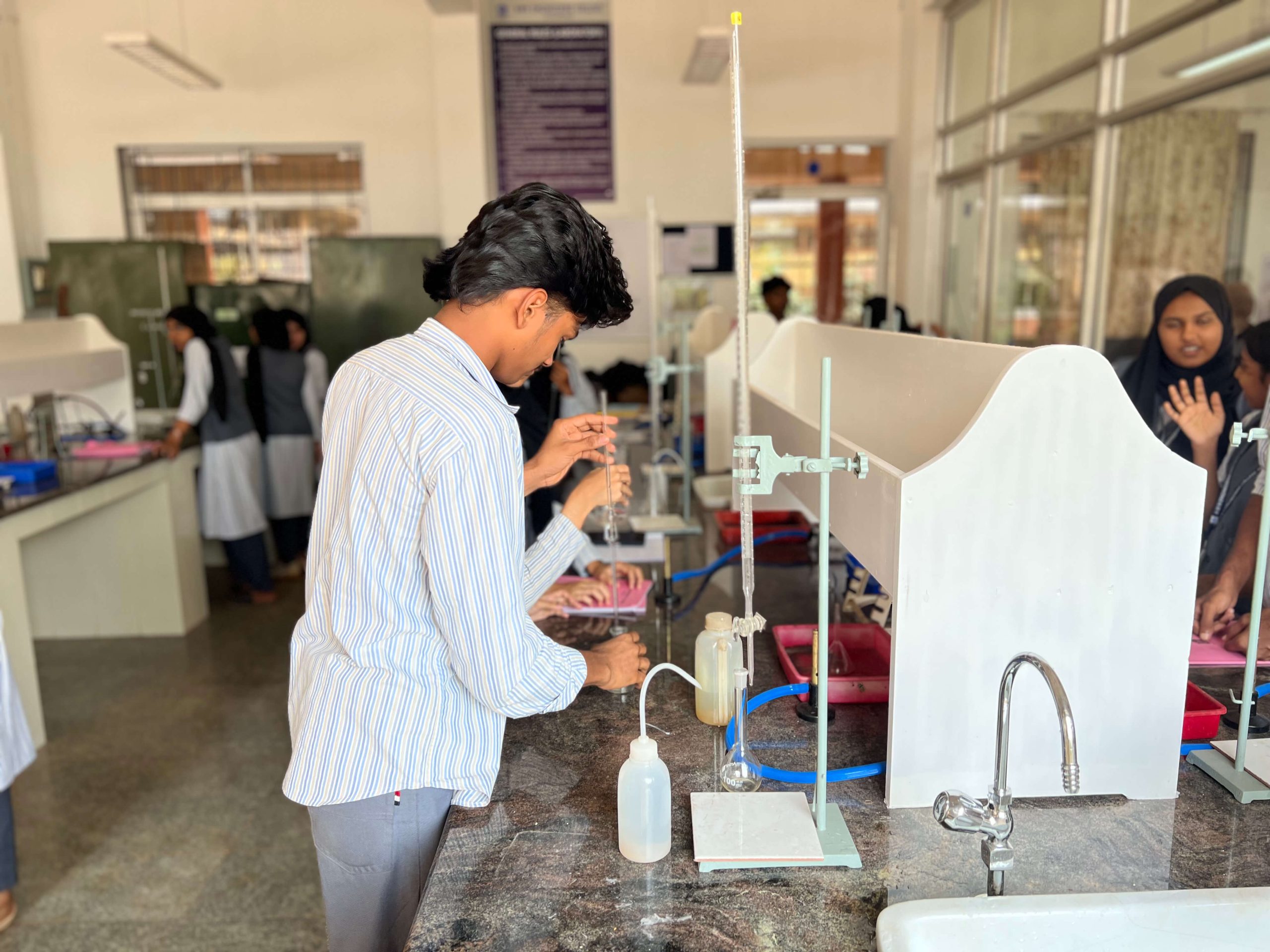
The Environmental Engineering Laboratory provides students with practical experience in water and wastewater quality testing procedures that are approved by IS. The department also offers evaluation and consultancy services pertaining to the analysis of water and wastewater quality. Essential tests for water quality analysis, including the determination of turbidity, conductivity, pH, acidity, alkalinity, chlorides, dissolved oxygen, available chlorine, BOD and jar tests, can be effectively conducted in this well-equipped facility.
Objectives
- Study the fundamental principles of environmental engineering, including water and wastewater treatment.
- Collect and analyse environmental samples, including water and wastewater, to determine their physical, chemical, and biological characteristics.
- Explore various water and wastewater treatment technologies, including physical, chemical, and biological processes.
Course Details
Available in Semesters 7 of Civil Engineering.
Key apparatus
- BOD Incubator
- Hot Air Oven
- Water Bath
- Muffle Furnace
- Jar Test
- Digital Nephelo Turbidity Meter
- Spectrophotometer
- Conductivity Meter
Learning Outcomes
Develop skills in designing and evaluating environmental systems, including water treatment plants and wastewater treatment plants.
Understand the fundamental principles of environmental engineering, including water and wastewater treatment.
Familiarize with various environmental engineering technologies, including physical, chemical, and biological processes.
Learn about environmental regulations, policies, and standards.
Develop hands-on experience with environmental engineering equipment and instruments, such as water and wastewater samplers.
Course leaflets
| SEMESTER | LEAFLET |
|---|---|
| B.Tech Civil Engineering S3 | S3 leaflet |
| B.Tech Civil Engineering S4 | S4 leaflet |
| B.Tech Civil Engineering S5 | S5 leaflet |
| B.Tech Civil Engineering S6 | S6 leaflet |
| B.Tech Civil Engineering S7 | S7 leaflet |
| B.Tech Civil Engineering S8 | S8 leaflet |
Department Library
The Civil Engineering Department Library is a vital resource designed to support the academic and research needs of students and faculty. With a diverse and expanding collection, the library aims to enhance learning, foster intellectual growth, and provide the tools needed for success in the field of civil engineering.
Our Mission:
- Support Academic Excellence:Provide access to an array of books, journals, and project reports to facilitate deep learning and research.
- Promote Information Literacy: Empower students and faculty with the skills to efficiently find, assess, and apply relevant information in their academic and professional pursuits.
- Cultivate a Collaborative Space: Create a conducive environment that promotes creativity, discussion, and collaboration, inspiring new ideas and innovative solutions.
Our Resources:
The library features a growing collection that includes:
- 300+ Books: Covering a broad spectrum of civil engineering topics, from structural analysis to environmental engineering and construction management.
- 100+ Main Project Reports: Featuring innovative student projects that demonstrate practical applications of civil engineering concepts.
- 150+ Seminar Reports: Offering insights into contemporary topics and advancements in the field of civil engineering.
- Industrial Visit Reports: : Providing valuable observations from site visits that connect theoretical knowledge with real-world practices.
With these resources, the Civil Engineering Department Library is committed to supporting the academic and professional journey of every student and faculty member, fostering a deeper understanding of the civil engineering discipline
Staff in charge

Mufeeda N K
Assistant Professor
Civil Engineering Department


Department Association
CIVIL ENGINEERING ASSOCIATION (CEA)

“Civil Engineering Association (CEA)” is the official student association of Department of Civil Engineering at AWH Engineering College, formed with the goal of providing opportunities for members to enhance their technical skills, knowledge and leadership abilities.
This association in association with ICI Student chapter plays a key role in organising workshops, seminars, technical and cultural fests, guest lectures, and inter-college competitions etc. The association have student leaders, faculty coordinator ensuring both leadership development and academic alignment.
Objectives of a Civil Engineering Association:
• Primary Objectives
1. Promote Professional Development: Enhance technical skills, knowledge and leadership abilities of members.
2. Foster Networking and Collaboration: Connect members with peers, professors and industry professionals for knowledge sharing and collaboration.
3. Advance the Civil Engineering Profession: Support the advancement of the Civil Engineering profession through advocacy, education and outreach.
• Educational Objectives
1. Technical Knowledge: Enhance technical knowledge and skills in Civil Engineering disciplines.
2. Soft Skills: Develop essential soft skills, such as communication, teamwork and leadership.
3. Research and Innovation: Promote research and innovation in Civil Engineering, encouraging members to explore new ideas and solutions.
• Career Development Objectives
1. Career Guidance: Provide career guidance and mentorship to members, helping them navigate their professional journey.
2. Job Opportunities: Facilitate job opportunities and internships for members, connecting them with industry leaders and organizations.
3. Professional Networking: Foster professional networking opportunities, enabling members to connect with peers and industry professionals.
Achievements
- Ms. Faseelath Valayankadan, Associate Professor of Chemistry, published a research paper titled ‘Identifying the Transients and Transformation Products in Hydroxyl Radical−Methimazole Reactions Using DFT and UPLC-Q-TOF MS/MS Approaches’ in an international journal indexed by Web of Science and Scopus.
- Ms Sudheela mol, Assistant Professor of Economics, delivered a talk titled on” Edify “on how students can achive success-14/10/2022
- Ms. Sudheela Mol M.S., Assistant Professor of Economics, received an appreciation letter from the Principal for achieving above 80% results in the S5 examinations-2022 odd semester.
- Ms. Faseelath Valayankadan, Associate Professor of Chemistry, received the Best Research Paper Award at the National Conference organized by the Inter University Instrumentation Centre, Mahatma Gandhi University, Kottayam.
- Ms. Sudheela Mol M.S., Assistant Professor of Economics, received an appreciation letter from the Principal for achieving above 80% results in the S4 and S6 examinations-2023 even semester.
- Ms. Sudheela Mol M.S., Assistant Professor of Economics, assigned as the college nodal officer of Udhyama1.0
Magazine/Newsletter
Magazine Release

2023

2022

2021
Magazine
| Technical Magazine 2023 | Click Here |
| Technical Magazine 2022 | Click Here |
| Technical Magazine 2021 | Click Here |
Newsletter
| Volume 12 | Click Here |
| Volume 11 | Click Here |
| Volume 10 | Click Here |
| Volume 9 | Click Here |
| Volume 8 | Click Here |
| Volume 7 | Click Here |
| Volume 6 | Click Here |
| Volume 5 | Click Here |
| Volume 4&3 | Click Here |
| Volume 2&1 | Click Here |
Downloads
2019 Scheme Question Papers
Students List
Contact us
Head Of The Department
| Faculty Name | Phone No. | College Address | |
| MS. JISHA P | +91 98473 33203 | hodce@awhengg.org | AWH Engineering CollegeKuttikattor, Calicut,PIN : 673 008, Kerala, India. |